Key takeaways:
- Custom welding automation cuts cycle times, keeps weld quality consistent, and reduces reliance on hard-to-find skilled welders. Those gains add up fast when you produce hundreds or thousands of parts.
- Off-the-shelf robotic cells often hit a ceiling at high volume because of generic fixtures, slow loading, and manual repositioning. A custom cell designed around your parts keeps the arc running.
- Systems are built from components matched to your parts and output goals, such as robotic cells, positioners, rotary welders, seam welders, custom fixtures, and material handling.
- ROI is strongest at high volume because fixed automation costs spread across more parts and the cost per weld drops.
Why High-Volume Manufacturers Are Investing in Custom Welding Automation
Custom welding automation for high-volume applications provides manufacturers with faster cycle times, consistent weld quality, and reduced dependency on scarce skilled welders. When you produce hundreds or thousands of identical parts each week, every second of cycle time and every rejected weld multiplies throughout the entire production run.
As the Bancroft Engineers state: “Even small inefficiencies can greatly affect profitability, quality, and delivery schedules.”
Therefore, an increasing number of trailer, exhaust, tank, agricultural, and structural manufacturers are transitioning from manual welding to automated welding systems designed specifically for their parts.
Why Off-the-Shelf Welding Cells Fall Short in High-Volume Production
A standard robotic welding cell may be a good starting point; however, high-volume production welding quickly reveals its limitations. Generic fixtures, slow part loading, pre-tacking requirements, post-welding operations, and manual repositioning all decrease arc-on time.
Industry experts agree that volume and repeatability are the primary areas where welding automation pays off. Welding gas and equipment suppliers indicate that “high-volume production with repetitive parts most clearly justifies automation.” Additionally, it’s recommended to calculate the number of welding hours required for your top ten parts to determine if automation is appropriate.
The challenge: a welding robot only performs as well as the system surrounding it. If upstream and downstream processes cannot keep up with the robot, the throughput advantages will be lost. Custom high-volume welding automation addresses this issue by designing the entire cell, from part presentation to unloading, based on your parts and quality requirements.
Key Components of a Custom High-Volume Welding Automation System
The optimal high-volume automation system is determined by part geometry, joint type, and desired output. Typical components include:
- Robotic welding cells and vision-guided robotic welding for complex, multi-joint assemblies
- Automated welding positioners to present every joint in the ideal position
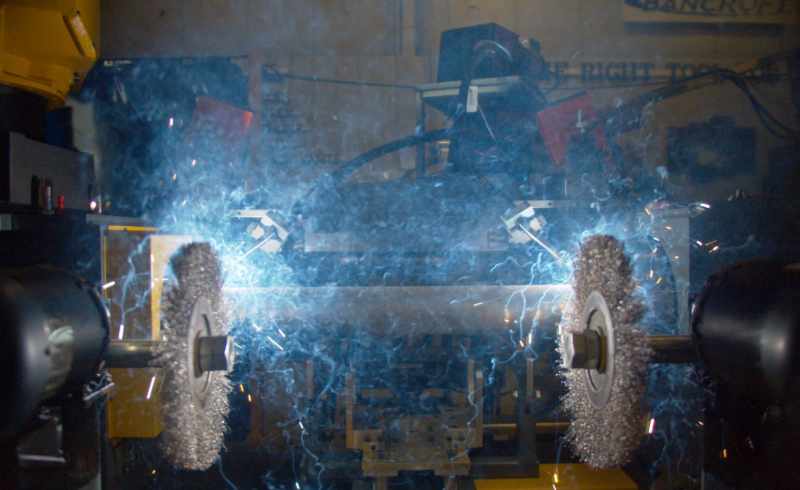
- Rotary welding systems and weld lathes for circumferential welds on tubes, axles, and tanks
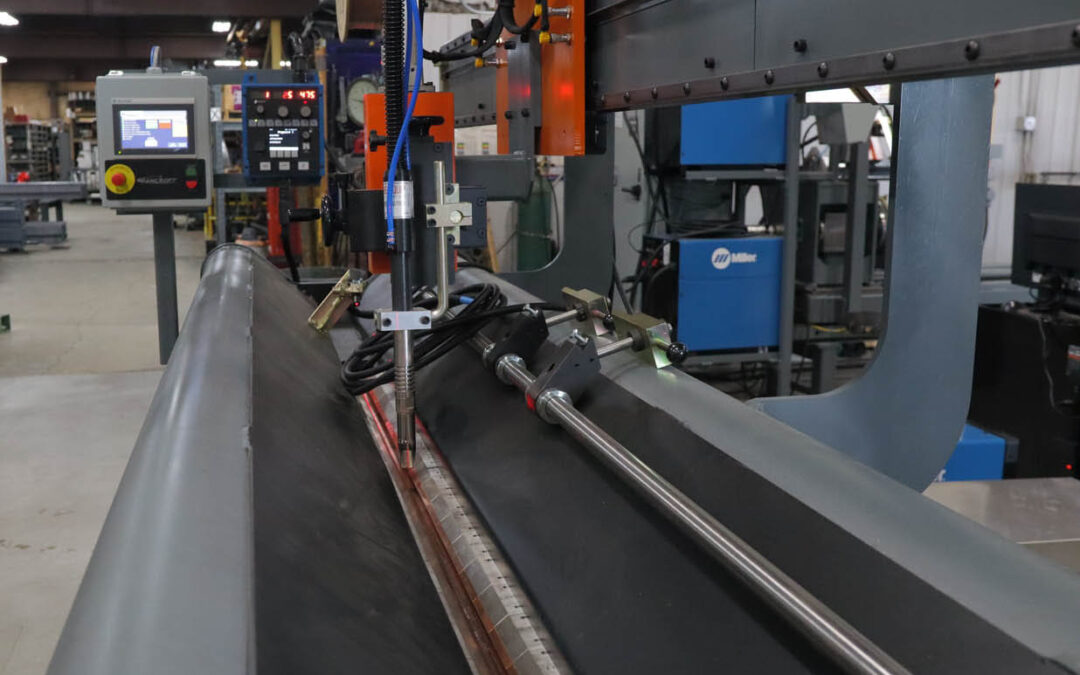
- Linear seam welders for long, straight seams on cylinders and flat panels
- Custom welding fixtures that locate parts quickly and hold tolerances shot after shot
- Material handling automation to cut load and unload time between cycles
- Fully integrated production cells that tie welding, handling, and controls into one line
Each component targets a different bottleneck, and together, they keep the arc running and the line moving!

The Business Benefits of High-Volume Welding Automation
#1. Faster Cycle Times + Higher Throughput
According to The Fabricator, properly configured welding automation “reduces cycle time by increasing arc-on time and deposition rates.” The result is more parts per shift, with less variability.
#2. Consistent + Repeatable Weld Quality
Automated welding repeats the same torch angle, travel speed, and parameters on every part. That consistency cuts rework, scrap, and inspection time, which matters most when you’re shipping thousands of welded assemblies to your customers.
#3. Less Dependence on Hard-to-Find Welding Labor
The skilled welder shortage isn’t easing! Assembly Magazine cites an American Welding Society projection that the U.S. will need 330,000 new welding professionals by 2028. High-volume welding automation lets one operator oversee output that once took several welders, freeing experienced people for setup, programming, and quality control.
#4. Stronger ROI
Because fixed automation costs spread across more parts, the cost per weld drops as volume rises. That makes high-volume production the strongest case for a custom welding automation investment.
Partner With Bancroft Engineering for High-Volume Welding Automation
Bancroft Engineering, located in Waukesha, Wisconsin, designs and manufactures custom automated welding systems for high-volume manufacturing. Its product line includes robotic welding systems, Welda-Round rotary torch welders, Weld-Lathe rotary part welders, automated positioners, seam welders, fully custom machines, and much more.
Bancroft has successfully implemented high-volume welding automation in exhaust welding, trailer axle manufacturing, and structural member fabrication. Each system is designed specifically for the customer’s parts, cycle time requirements, and floor space.
Frequently Asked Questions for High-Volume Welding Automation
Q: What is custom welding automation?
A: Custom welding automation is a welding system designed specifically for a particular part and production requirement, utilizing robots, positioners, fixtures, and controls instead of relying on a single generic cell.
Q: When does welding automation make sense for high volume?
A: Welding automation provides the greatest ROI on repetitive parts that are produced in high volumes for extended periods of time, particularly when manual welding is a capacity bottleneck.
Q: Can robotic welding assist with the shortage of welders?
A: Yes! Automated welding systems enable you to produce more parts while decreasing your reliance on difficult-to-hire skilled welders.
Q: Which industries obtain the greatest benefits from high volume welding automation?
A: Examples include trailer, exhaust, hydraulic cylinder, pipe & tube, agricultural equipment, tank welding, structural member, industrial equipment and even small manufacturers typically experience the most significant advantages.